
Hirer guilt: The saboteur of good probation conversations
Line managers who have invested time, budget and personal reputation to select a new hire can experience 'hirer guilt' when the selected candidate's performance is not at the required standard.
To admit a new hire is struggling can feel like they're admitting an error of judgment. - it's a form of the cognitive bias known as the sunk cost fallacy: We carry on defending what we have 'sunk' something of value in to (time, budget, reputation) for way longer than, logically, is the right thing to do.
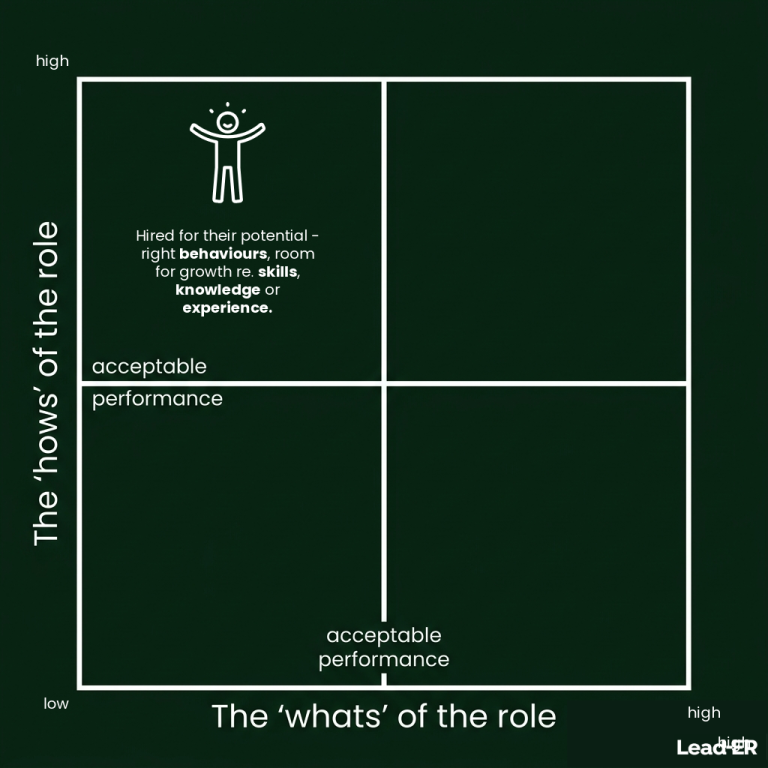
Rather than asking managers to rip the metaphorical plaster off and acknowledge it's not worked out, the what/how 4-box grid can help in two ways:
1) It unearths the evidence of the misalignment between expectation of performance and the reality. This makes the manager/new hire conversation fact-based, and so more comfortable to tackle (albeit still not easy); and
2) It looks back to the hiring decision itself: Not to find fault, or to blame, but to identify whether the ecosystem of support that was envisaged when the decision to hire was made, has in fact materialised. Here's why this second point matters:
Case example
Imagine a scenario: A new hire is selected on the basis of their potential': They're a living embodiment of the required behaviours and the Values - they are, therefore, a good 'organisation fit'. But it's recognised that they are not the complete picture when it comes to the experience, skills and knowledge.
Let's call this person Ann Example...
The hiring manager located Ann in the top left quadrant of the grid and selected them based on potential.
The selection process that followed the initial interview reinforced Ann's 'organisation fit': The team met Ann and validated the manager's view. The head of department met Ann and quizzed them hard on the organisation's Values, in which conversation Ann shone.
What happened next?
Ann accepted the offer, and time passed before she started in role. The organisation celebrated a successful recruitment and Ann's potential was eagerly anticipated. Time passed between offer and onboarding and in that time, the manager forgot what Ann needed by way of support to deliver the 'whats' in order to achieve 'top right' performance.
Ann's performance during her probation did not match up to the potential the manager had identified.
The hiring manager used the 4-box grid to go back to the reason for hiring Ann and diagnosed the cause of the gap between her potential and the reality of her current performance. It was this: The support ecosystem that had been the basis for selecting Ann had simply got overlooked.
The bottom line
The introduction of the 6 month qualifying period for unfair dismissal protection has shifted the employment law landscape. Tools such as this 4 box grid gives busy managers structure to assess candidates and to follow through to plan onboarding and probation plans that are tailored to the successful candidate's individual needs.
And, if evidence of underperformance is needed - it gives a basis for assessment that managers can rely upon too.
...and a final word
This 4-box grid technique features in 10to3's recruitment, performance and probation collection of videos.